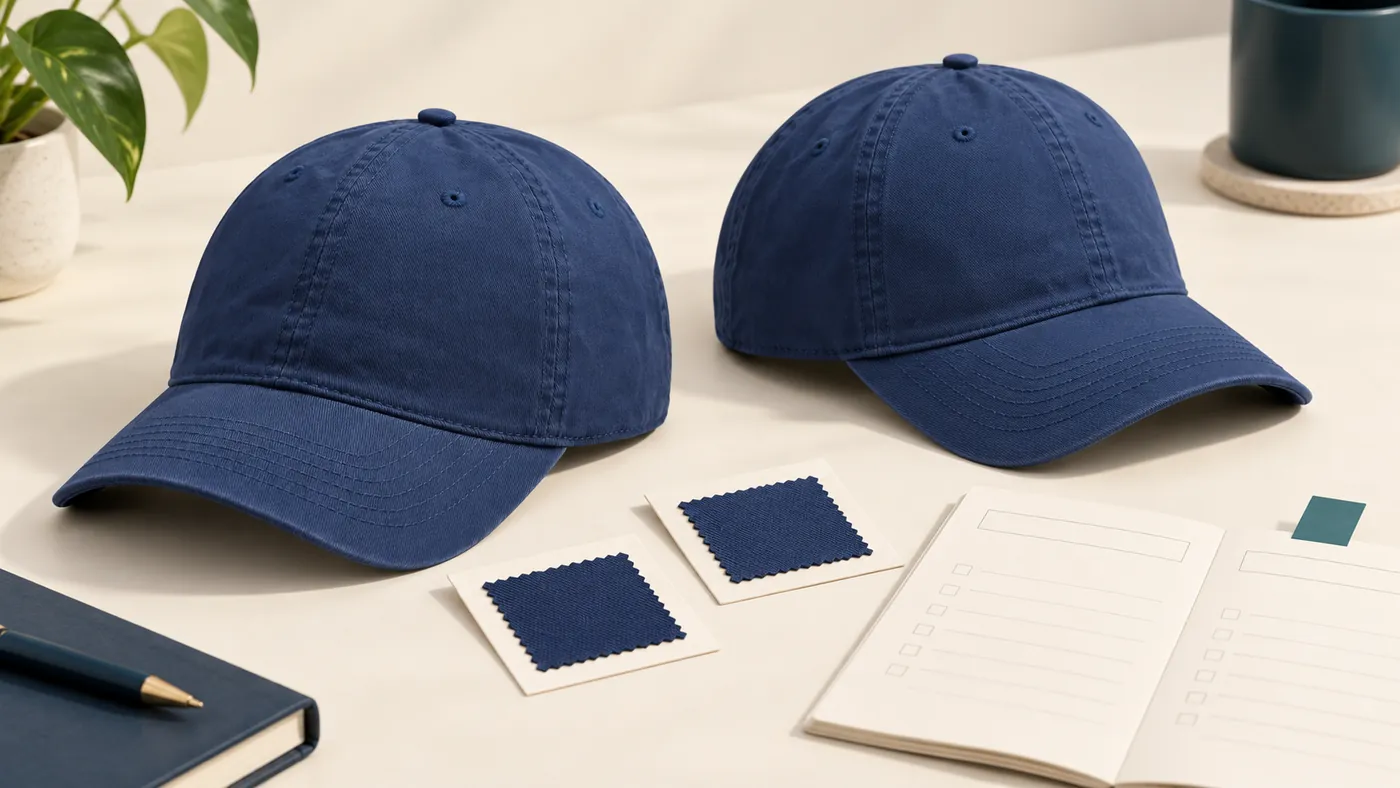
A repeat order needs a current specification
“Please repeat our last hats” is a useful opening message, but it is not a complete repeat-order brief. The previous project may contain several artwork files, different sample stages and emails that changed individual details. A purchasing team needs to identify which version was actually accepted and which parts of the new request remain the same. That is the foundation for a clear discussion with the supplier.
Good repeat-order planning connects the accepted sample, written specification, artwork and quantity schedule. It also asks which records and physical references are still available. This guide describes buyer-side record keeping and review decisions, not a claim that Relia Hats stores patterns, production files or samples indefinitely. Relia Hats can discuss custom hats from customer requirements or drawings, customer-specified materials and customer logos; current scope and arrangements need confirmation for the new project.
Find the approved baseline before describing changes
Begin with the prior order reference and the exact approval record. If the buyer reviewed several samples, identify the one that established the accepted specification. Give it a clear reference, date and status. An earlier development sample can be useful background, but it should not be allowed to replace the final approved version simply because its photograph is easier to find.
Keep the physical sample and its written description connected. Record where the buyer's sample is held and whether it is available for comparison. Ask the supplier whether a corresponding sample or record is still available, and what it represents. If the references disagree or one is missing, mark that issue as open. Do not resolve it by silently choosing a convenient image from an old email chain.
Describe the scope of the previous approval. Was it a shape sample, an undecorated material sample or the complete hat with its final logo and trim? That distinction matters when preparing a repeat. The sample inspection and approval guide provides a structure for recording material, fit, colour and artwork decisions together.
Keep a compact specification pack
Material and construction record
List the approved body material and the relevant component descriptions separately. Include crown layout, brim shape, inner band, lining, closure and trim where they form part of the design. Retain any agreed composition statement with the version it covers. A broad description such as “same mesh cap” does not identify every component that the buyer expects to receive again.
Fit and colour record
Keep the accepted size description, measurement positions and selected colourway references. Preserve the complete units originally agreed. If your previous project used more than one size, maintain the relevant combination for each row rather than replacing them with an overall “adult” label. Colour references should identify the arrangement across components, not merely a general family such as green or black and white.
Artwork and trim record
Retain the approved artwork file, revision, finished dimensions, position and decoration direction. Include the visible sample reference used for approval. If a patch, ribbon or other accessory was part of the accepted design, identify its material, shape, colour and attachment requirements. File ownership, reuse rights and supplier retention arrangements need an actual agreement; keeping a buyer reference does not establish those terms.
Make changes visible in a comparison log
Use a change log to show the previous accepted value, the new requested value and the decision still required. “No change requested” is useful wording when a buyer wants to preserve an element. It is not proof that the supplier has already confirmed the same component or arrangement for the new order. Ask the supplier to review the current proposal against the baseline and identify any differences.
Distinguish a buyer request from a supplier proposal and an accepted change. Those are three different statuses. A suggested replacement material should remain a proposal until it has been reviewed and accepted. Likewise, a buyer's new logo file should not become the production reference merely because it was attached to an exploratory email. Give each consequential decision an explicit status and a reference to its supporting record.
A short change description is more useful than a long message that mixes decisions and questions. For example, “Logo width revised; material and placement unchanged as requested; decorated sample review pending” identifies the affected area and the open step. It does not claim that the change is technically accepted or that a sample has already been approved. Keep the written status aligned with what has actually happened.
An illustrative repeat-order review
Consider an illustrative buyer who previously selected a five-panel mesh-rope cap and now wants a second project with a revised customer logo. The buyer also mentions a different green shade. This is a hypothetical document example, not a completed customer case, a production promise or an indication that any specific repeat quantity is available.
The mesh-rope golf reference helps illustrate why the colour wording matters: Deep Green and Dark Green are separate selections, and the stated size option is 56–60cm (22.05–23.62in). A repeat inquiry should identify the exact prior shade, the proposed new shade and the selected size. “Same green cap” is insufficient when the buyer actually intends to change one of those decisions.
| Item | Previous baseline | New request | Next decision |
|---|---|---|---|
| Cap reference | Identified approved sample | No design change requested | Confirm current proposed construction |
| Colour | Approved shade reference | Different named green under discussion | Approve selected shade and component arrangement |
| Logo | Approved artwork revision | New artwork revision | Confirm dimensions, placement and decorated result |
| Quantity | Previous order schedule | New quantity matrix to follow | Review current combinations and project terms |
Notice that the new logo and shade do not erase the baseline. The buyer retains the old references, labels the changes and asks what needs reapproval. If the supplier proposes another component difference, it enters the same log. This gives the new project a clear identity without relying on a vague instruction to repeat everything except the details mentioned in passing.
Ask what records can actually be used again
Before depending on an earlier file or sample, ask whether it is still available and suitable for the proposed repeat. Be specific: the accepted sample, artwork revision, drawing, component reference and approval correspondence are different items. The answer may differ for each. Do not assume that a past order number means every supporting record remains available in the same form.
Clarify which party will provide missing references and how disagreements will be resolved before acceptance. If a complete baseline cannot be established, a new specification review may be more appropriate than treating the project as an unchanged repeat. Ask about any applicable development, sample or file arrangements rather than assuming they are free, automatic or covered indefinitely by the previous order.
Decide the reapproval scope before release
Changes in artwork, material, fit, colour or trim should prompt a discussion about what must be reviewed again. The appropriate scope depends on the actual change and the buyer's requirements. This article does not prescribe a universal sampling policy. Record the agreed review step and the version to which it applies so that a partial approval is not mistaken for acceptance of the entire finished hat.
If an earlier performance report or other technical evidence matters to the repeat, confirm its relevance to the current version. Keep the report's product scope and conditions with the specification. A new component or decoration arrangement should not silently inherit a previous claim. Conversely, do not ask the design record to prove matters that require separate applicable evidence. Make those responsibilities visible in the project discussion.
Confirm today's quantities and commercial conditions
The previous price, quantity split or delivery arrangement is historical information, not automatic acceptance of a new transaction. Supply a current size and colour quantity matrix, destination, packing requirements and requested date. Ask for the applicable project terms, including any sample or development arrangements that need review. Keep the current quotation separate from the older reference documents.
Give the final repeat pack a clear revision and approval status. Name one current specification, artwork schedule and quantity matrix as the set being discussed. Mark earlier versions as superseded without deleting their decision history. A clear handover tells the next person which files to use and which are retained only as background. The custom hat order process places that handover within the broader project route.
A repeat-order procurement checklist
- Identify the previous order, accepted sample and exact scope of its approval.
- Keep material, construction, dimensions, colourway, logo and trim references together.
- Record every requested or proposed difference with its status and supporting revision.
- Confirm which files and samples are actually available and who supplies missing references.
- Agree the current reapproval scope and any evidence that must cover the revised design.
- Provide today's quantity schedule, destination, packing brief and requested conditions.
Questions buyers often ask
Is an old product photograph enough?
It is useful context, but it may not identify the accepted materials, dimensions, artwork revision or approval scope. Connect the photograph to the written baseline and relevant sample.
Should we delete old artwork after a revision?
Keep a clear history while identifying one current approved file. Mark older files as superseded so they are not accidentally reused. Storage and ownership arrangements should be agreed separately.
Can a repeat be quoted before every change is settled?
You can start a discussion with open points clearly listed. Keep any proposal conditional on those points rather than presenting an unfinished brief as a final accepted specification.
How do we begin a repeat inquiry?
Send the previous order and sample references, the current specification pack and a concise change log. Discuss your repeat hat brief with Relia Hats and identify the versions and current arrangements that need confirmation.