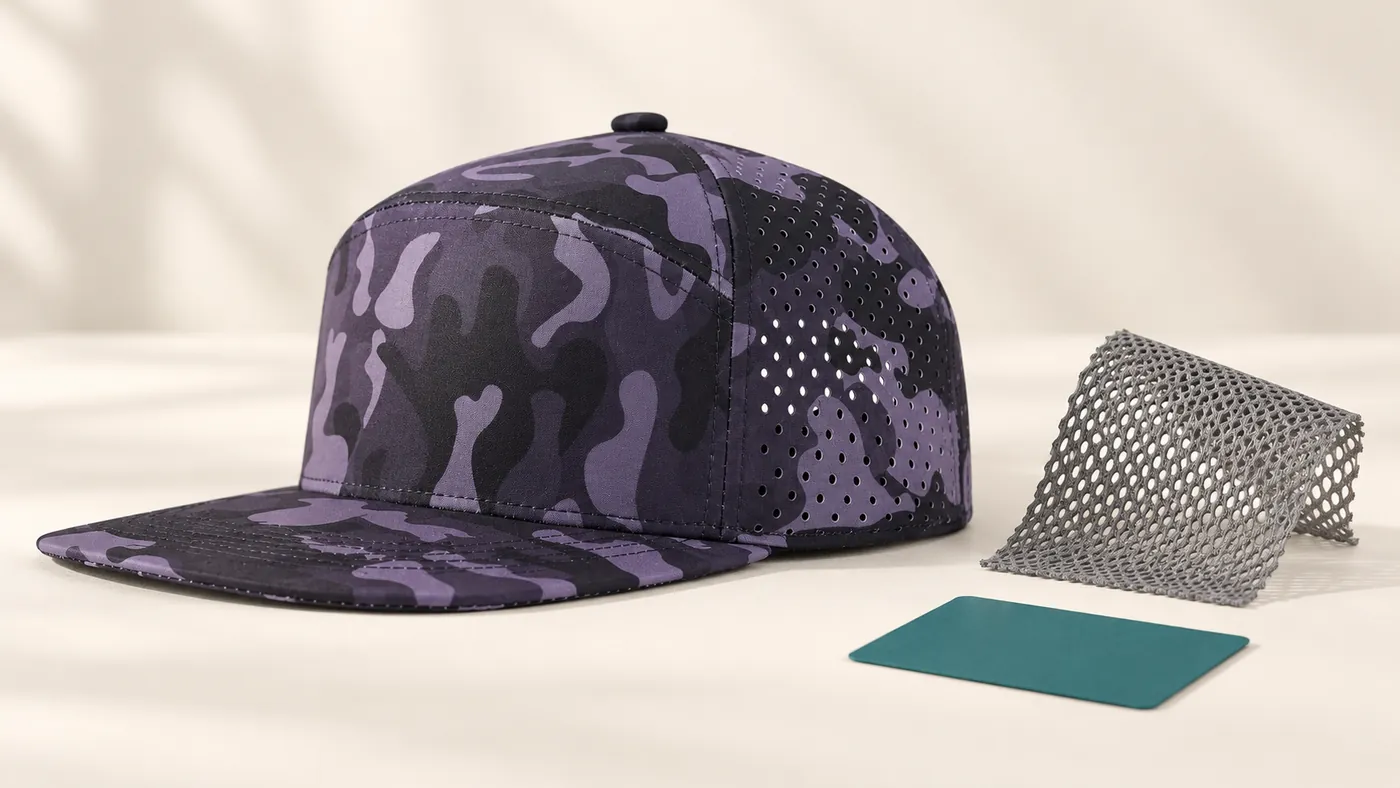
Compare what the cap is built from before comparing a performance claim
Mesh panels and laser-perforated surfaces are useful construction details to discuss when choosing a cap. They tell a buyer where to look and which questions to ask. They do not, on their own, provide a measured result for airflow, drying, water resistance or sun protection. A better sourcing brief starts with the exact cap, maps its components and defines the intended use before requesting evidence for a particular claim.
This approach is practical for a golf-inspired collection, a running-style design or a casual trucker project. Instead of asking which cap is “most breathable” without a comparison basis, identify the construction you want to evaluate and the result that matters to your buyer. Relia Hats can discuss designs based on your requirements or drawings, customer-specified materials and customer logos. The final material, decoration and evidence requirements should remain attached to the selected design.
Map mesh, perforation and solid areas separately
Describe the actual mesh placement
Record whether mesh appears on the side, rear or another part of the crown. Ask for a clear view of the inside as well as the outside, because a surface view does not describe every backing or lining component. A front panel and a rear mesh panel may have different construction and decoration needs even when the whole hat is marketed under one material description. Put each relevant component in its own line in the specification.
Identify the perforated area
For a laser-perforated proposal, mark which panels contain the openings and describe the pattern that the buyer is approving. Request dimensions or an annotated drawing where the opening layout matters. Keep the size and spacing discussion tied to the selected sample. Do not take the name of a cutting process as proof of a particular opening geometry, structural result or wearing benefit across every cap in a collection.
Keep the rest of the cap in the comparison
Include the front panel, bill, sweatband, rear closure and any internal support in the component review. A buyer comparing only the visible holes can overlook a different crown shape or fit range. These details also help explain why two similar-looking sports-style caps should not be treated as identical specifications. The materials, construction and fit guide connects these component questions with the complete hat brief.
Use real catalogue contrasts to make the brief precise
The six-panel nylon mesh baseball-cap reference identifies a metal buckle and two stated circumference ranges, 56–58CM and 58–60CM. Those details support a concrete inquiry: which range applies to the selected version, where are the mesh and perforations, and what are the component materials? They do not establish a drying time or rain rating. A buckle described as metal also needs its actual composition and finish confirmed when those details matter.
A different five-panel short-brim trucker reference offers M 56–59cm and L 60–62cm options. This makes fit and bill shape part of the comparison, alongside the openings. Adjustment is described, but the operating mechanism and usable fit need confirmation. Neither the adult label nor an adjustable description should be used to extend the stated size ranges.
A third mesh-rope reference describes Polyester/Cotton, five panels and a 56–60cm (22.05–23.62in) size option. Request the actual fibre percentages and component scope for that chosen version rather than inventing a blend ratio. The three examples illustrate different questions to resolve. They are design references, not a ranked performance comparison, and their specifications should not be pooled into a single hybrid cap.
Write the intended conditions in buyer language
Describe where and how the proposed hat will be worn. A golf-outfit brief might prioritise the crown profile, bill curve and appearance of the customer logo. A running-style inquiry might ask for evidence about a particular moisture or drying requirement. A casual summer collection might focus on the visible perforation pattern and colour balance. These are different purchasing priorities even if the initial product photographs look related.
State the expected activity, exposure and any relevant duration as requirements to discuss. If the customer wants to publish a technical claim, include the exact proposed wording. This gives the supplier a defined question rather than an open request for “high performance.” Keep aesthetic choices and measured requirements in separate fields so an attractive sample can be approved visually without accidentally approving an unsupported technical statement.
Build an evidence request around one claim at a time
A useful evidence request names the claim, identifies the product version and asks how the result was obtained. For any quantitative comparison, request the applicable method, conditions, result and scope. Ask whether the evidence covers the material alone, a component or the complete decorated hat. If the report describes a different construction, the buyer should clarify its relevance before using it to support the selected product.
Keep airflow, drying, water resistance and sun protection as distinct questions. Evidence for one does not automatically answer the others. This article does not assign a test standard, pass threshold or numerical rating because those requirements depend on the intended claim and applicable project conditions. The buyer and supplier need to agree what evidence is required, and an appropriately qualified adviser may be needed for a market-specific claim.
The same discipline applies to comparison language. “Better” needs a defined alternative and comparable conditions. If two proposals are evaluated with different methods or different sample constructions, their figures cannot simply be placed side by side as a fair ranking. Record what is actually comparable and what remains unresolved. This creates a more useful decision record than a broad performance adjective in an email.
Review decoration where it will actually sit
Supply the artwork, desired dimensions and intended position on the selected cap. Mark whether it belongs on a solid panel, near a perforated area or across a seam. Ask which embroidery, print or patch direction can be evaluated for that location and material. A process named for one catalogue reference is not a promise that every artwork can be applied to every mesh or perforated design.
On the decorated sample, inspect the relationship between the artwork and the openings, the seam placement and the interior finish. Confirm what is included in the proposed version, including any existing rope or other trim. If decoration changes after evidence has been reviewed, ask whether the evidence still applies. The sample approval guide helps keep material, fit and artwork decisions together.
An illustrative comparison board for a cap project
Imagine a buyer comparing two concepts for a branded outdoor-event collection. This is an illustrative planning exercise, not an actual customer case or a promise of performance. Concept A uses a visible mesh rear with a solid artwork area; Concept B uses a perforated panel layout. The buyer wants a similar visual identity but has not yet approved either sample or made a technical claim.
The comparison board has four columns: confirmed construction, open specification points, evidence requested and approval status. Under construction, the buyer records panel layout, bill shape, closure and stated size. Under open points, the buyer lists component composition, backing and exact logo placement. Under evidence, the buyer writes the specific claim that would need support. The status column stays “under review” until the relevant decision has actually been made.
This board allows a visual decision and an evidence decision to proceed clearly. The buyer may prefer one silhouette while still waiting for material confirmation. Alternatively, a proposed claim may be removed while the design continues as a casual-style product. Neither outcome requires pretending that a hole pattern alone proves performance. The important step is to keep the approval scope visible to everyone preparing the specification.
Procurement checklist before the sample is accepted
- Identify the exact reference and revision, including mesh location, perforated panels and solid areas.
- Confirm component materials, stated size options, crown structure, bill geometry and closure operation.
- Attach artwork dimensions and position, then review the decorated sample inside and outside.
- List each proposed performance claim separately, with the evidence and product version it requires.
- Record the actual result, method, conditions and limitations of any evidence supplied.
- Keep material, decoration or construction changes linked to the next approval decision.
Questions buyers often ask
Are mesh and laser perforation interchangeable descriptions?
Use them to describe the construction actually proposed, rather than treating them as equivalent material specifications. A selected design may use both. Confirm the location and composition of each component.
Can a sports-style product name establish a technical rating?
No. Running, golf or outdoor styling can describe the intended design direction. A technical rating requires applicable evidence for the claimed property and product scope.
What if no performance report is available?
Record that the claim is not yet supported. You can continue discussing appearance, fit and construction while deciding whether evidence is necessary for the intended project. Do not turn an unverified requirement into a public guarantee.
How can I start a construction discussion?
Send the reference, intended wearing conditions, size and material requirements, plus the customer-logo brief. Discuss your cap construction and evidence requirements with Relia Hats so the open decisions can be reviewed for the selected design.