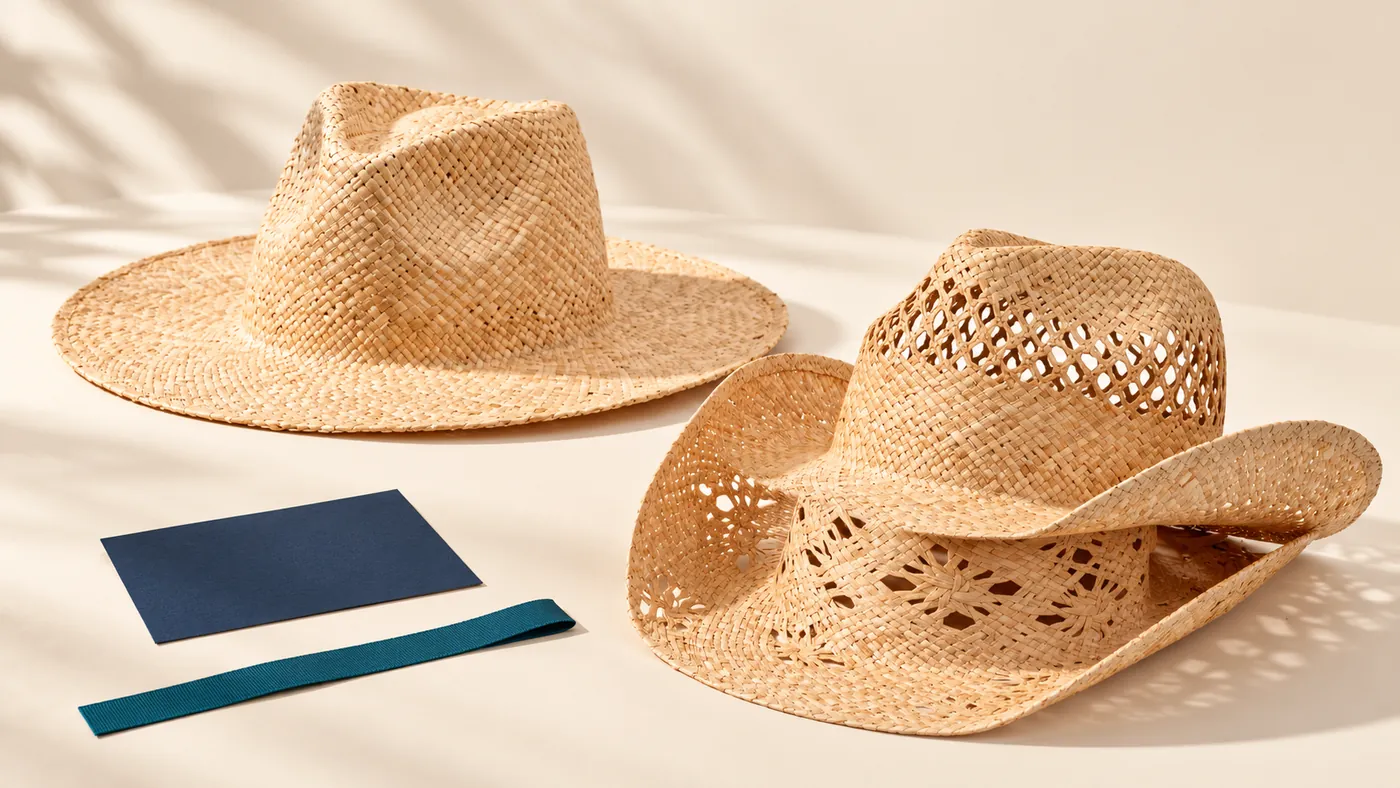
Start with the material question behind the summer silhouette
A wide brim, an open weave and a natural-looking colour can make several hats appear closely related in a sourcing presentation. Those visual similarities do not establish that their materials, shape retention or care requirements are interchangeable. A useful straw-hat inquiry separates the material description from the finished design, then connects both to an approval sample. This is especially important when your brief moves between straw, paper straw and a product described as papyrus fibre.
For a business buyer, the first task is to specify what must remain consistent: the visible weave, the crown shape, the wearing dimensions, the trim or a particular material requirement. A reference photograph can communicate the intended look, but it cannot answer every composition question. Send the image alongside a written description of the components you want confirmed. Relia Hats can discuss hats developed from customer requirements or drawings, customer-specified materials and customer logos.
Use material names as questions to resolve
Straw is a starting description, not a complete component schedule
When an inquiry says simply “straw hat,” ask which material the selected hat actually uses and which part of the hat that statement covers. Record the outer woven body separately from the inner band, lining, ribbon, cord and decorative accessories. If the buyer requires a particular composition, put that requirement into the brief rather than relying on a category name. The final specification should identify the material that the supplier is proposing for the chosen version.
Keep paper straw explicit
Paper Straw is the stated material for several Relia catalogue references, including a rigid-crown lace-up cowboy design and a floral-embroidered western design with a concho belt. Those are useful starting points for discussing appearance and construction. They do not establish a common treatment, coating or complete recipe for every paper-straw hat. Ask about the woven body, any applied finish and the other components individually, particularly if the finished product needs specific cleaning or exposure instructions.
Confirm what a papyrus-fibre proposal includes
The catalogue also includes Khaki papyrus-fibre openwork woven headwear. Its material wording identifies the discussion to have; it does not by itself provide a complete composition statement or settle the crown construction. For that reference, confirm whether the proposed version has a covered crown or an open visor arrangement. A buyer seeking a particular fibre must obtain the precise composition for the actual sample, rather than treating similar summer styling as proof of equivalence.
These distinctions also help prevent unsupported environmental language from entering a sales brief. A pale colour, plant-related material name or woven surface is not enough to support a recycled-content, biodegradability or other environmental claim. If such a claim matters to your project, define exactly what you intend to say and request evidence covering the relevant material and finished product. Keep that evidence separate from the aesthetic reason for choosing the hat.
Translate the outline into measurable shape
Once the material direction is clear, define the geometry that makes the design useful. “Wide brim” is a helpful visual description, but it is incomplete as an acceptance instruction. Request the actual brim measurement and explain where it should be taken. If the front, sides and rear differ, identify those positions in the drawing. Include the intended curve or upturn, the brim edge treatment and how firmly the brim should hold its approved profile.
Do the same for the crown. A rigid-crown western reference and an openwork summer reference may need different review questions. Specify crown height, the desired top profile and the shape seen from the front and side. Attach annotated views where the silhouette is important. If a buyer changes the crown depth while retaining the original circumference, the sample still needs a wearing review; a single size number does not describe the whole interior.
The lace-up Paper Straw reference states a circumference of 56–58CM (22.05–22.83in). Use that complete range when discussing that exact product. Do not expand it into a universal fit range for every brimmed design. Ask whether an adjustment arrangement is actually present and, if so, how the selected version operates. Keep the intended wearer measurements and any inner-band changes alongside the finished hat measurements in the approval record.
Approve weave and trim together
A weave should be reviewed as part of the finished hat, not only as a small material swatch. Ask which opening pattern, strand appearance and colour are being proposed. For a striped design, note how the stripes should read across the crown and brim. If openwork is part of the visual brief, identify its location and intended appearance without assigning an airflow or sun-protection rating from the openings alone.
Trim can change the character of the same underlying shape. On the floral-embroidered paper-straw western reference, the embroidery and concho belt deserve their own approval fields. Record the floral pattern, colours, scale and placement, then the belt width, material, hardware description and attachment. Do not infer the metal composition or finish of a decorative piece from its colour in a photograph.
For a lace-up design, confirm whether the lace is included, how it is arranged and how its ends are finished. If handwork is a purchasing requirement, ask which operations are actually performed by hand. A handmade-style appearance is not a substitute for an agreed process description. Photographs of the selected sample can support the written record, particularly where the buyer wants a specific relationship between the trim, weave and crown shape.
Plan the customer logo around the selected surface
A logo request should identify the surface on which the artwork will sit. A ribbon band, a patch or the woven body creates different questions, so avoid a brief that says only “add our logo.” State the proposed dimensions, position, colour and appearance. Ask which decoration approach can be evaluated for that exact combination of material, weave and trim. The logo and artwork guide provides a broader framework for that discussion.
Review the finished result at the intended viewing scale. Check whether small text remains legible and whether a design crosses openings, ridges or existing decoration. If the original reference already has floral embroidery, identify which elements remain and which are to change. A new logo should not silently replace an approved decorative feature. Record the artwork revision with the sample so the buyer is approving the complete visual arrangement.
Work through an illustrative sourcing comparison
Consider an illustrative buyer preparing headwear for a summer retail collection. The buyer likes a rigid western silhouette but is also comparing a softer-looking openwork reference. This is a planning example, not a quotation, completed customer project or statement of availability. The productive comparison begins by keeping two separate design records rather than combining attractive details into one ambiguous request.
For the western option, the buyer requests the Paper Straw body, the intended rigid crown, the measured brim profile and a selected lace arrangement. For the openwork option, the buyer asks for the precise papyrus-fibre composition, crown or visor construction and the chosen trim. Both records include finished circumference and sample photographs. A common customer logo is described separately for each surface, because its location and execution have not yet been approved.
The buyer then compares the proposed samples against the actual collection brief: appearance on the intended wearer, consistency with the artwork and the agreed handling needs. There is no need to invent a universal material ranking. One design may be the better match for a particular silhouette or presentation, while another may answer a different aesthetic brief. The decision becomes clearer when the comparison uses confirmed components and measured shapes.
Agree packing, handling and care before acceptance
Do not assume that a woven summer hat can be folded, rolled or compressed for transport. Ask how the selected finished shape should be packed and what handling restrictions apply to the complete hat. Include the crown, brim, trim and added logo in that discussion. If you intend a particular retail presentation, send its dimensions and describe how the hat will be supported, displayed and unpacked.
Request care instructions for the exact construction. Clarify moisture exposure, cleaning, drying and storage with the supplier rather than transferring instructions from a different straw-like product. If sun protection, breathability or another performance claim is required, ask for applicable evidence and its scope. Those questions belong in the project specification; an outdoor or beach styling description does not establish a measured result.
A procurement checklist for a brimmed-hat brief
- Identify the reference, proposed material and complete component scope, including finishes that need confirmation.
- Attach crown and brim drawings with measurement positions, profile views and the required circumference.
- Describe weave appearance, colour reference, trim dimensions and which decorative pieces are included.
- Supply the customer-logo revision, intended dimensions, location and sample-approval requirement.
- List any requested performance evidence by claim and exact product version.
- Agree the selected shape's packing, handling, care and final approval record.
Questions buyers often ask
Can paper straw and papyrus fibre be approved as the same material?
Keep the descriptions separate until the supplier confirms the actual composition and the buyer approves any proposed substitution. Similar colour and weave appearance are not enough to establish material identity.
Does a wide brim mean a stated sun-protection rating?
No rating follows from the style description alone. If a rated claim is part of your requirement, request the applicable method, conditions and results for the selected construction.
What should go into the inquiry first?
Send a reference or drawing, the material requirement, crown and brim details, size, trim and logo. Then identify the points still open. Send your brimmed-hat brief to Relia Hats to discuss the proposed design and project-specific arrangements.